The short answer
- A new four-head starts around $25,000; six-heads run $25,000–$55,000 by brand
- Tajima is the premium end at $30,000–$50,000 for six heads, Ricoma the most affordable
- Top machines reach 1,200 stitches per minute with 15 needles per head
- Heads only pay when your order quantities fill them — six heads on 4-piece orders is four idle heads
- Warranty ranges from 5 to 7 years and is a real part of the price
Adding heads is the standard way an embroidery business grows, and it is the decision most often made on capacity rather than on order shape. A six-head machine does not produce six times the output of a single head — it produces six times the output of orders large enough to fill it, and that distinction decides whether the purchase pays.
What is an additional head actually worth?
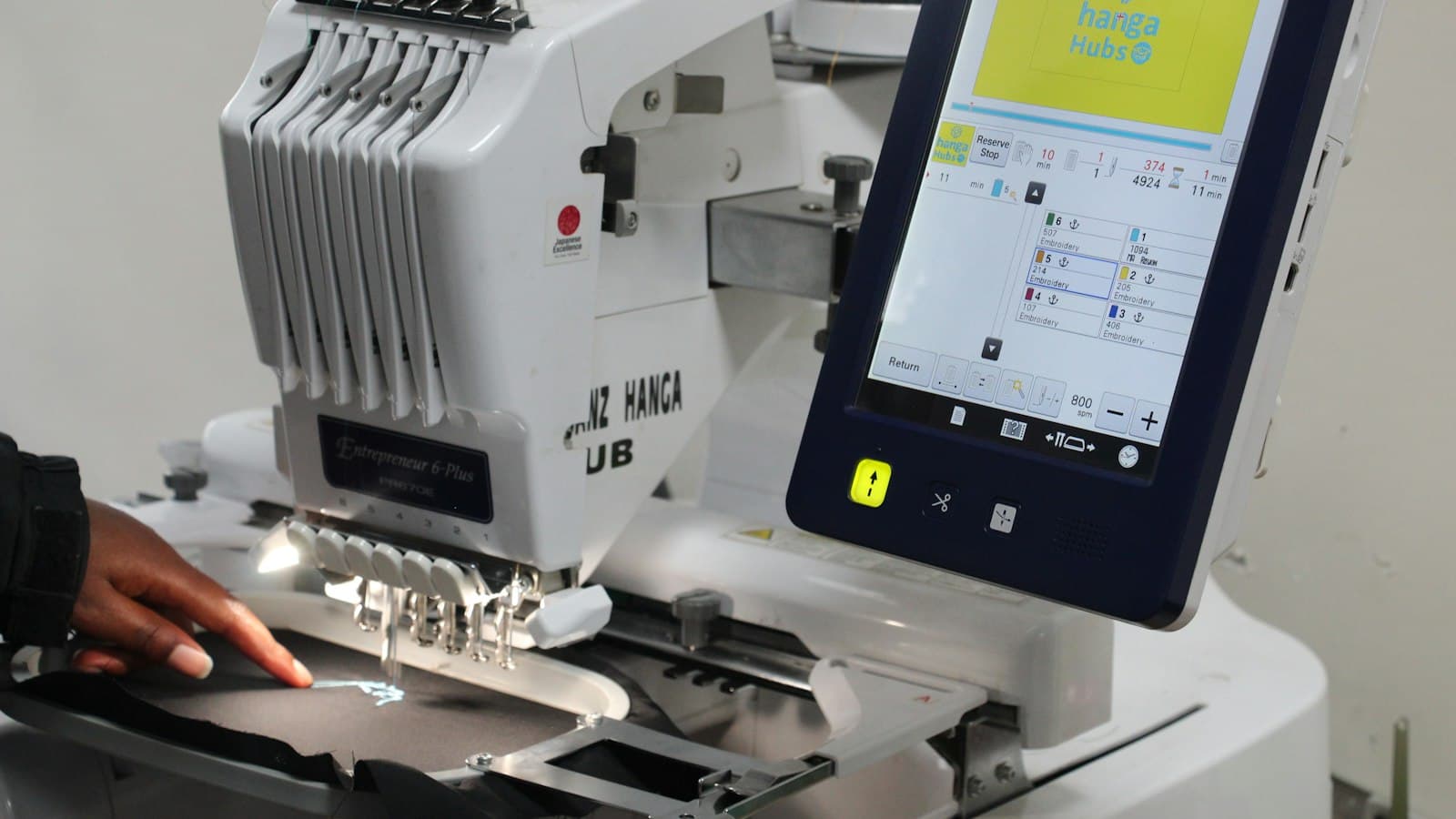
Each head embroiders one garment simultaneously from the same design file. Six heads means six garments stitching at once, so a 12-piece order runs as two cycles rather than twelve.
That is a genuine multiplier and it applies only within a single design. Heads run the same file at the same time; they do not run different jobs. So the value of a head is entirely a function of how many identical garments your typical order contains.
| Order size | Cycles on 1 head | On 4 heads | On 6 heads |
|---|---|---|---|
| 4 garments | 4 | 1 | 1 (2 idle) |
| 12 garments | 12 | 3 | 2 |
| 24 garments | 24 | 6 | 4 |
| 48 garments | 48 | 12 | 8 |
Look at the first row. On a four-garment order, a six-head machine and a four-head machine take exactly the same time, and two heads are threaded, maintained and financed for nothing.
The price bands
| Configuration | Published range |
|---|---|
| Four-head, new | from around $25,000 |
| Six-head, SWF | $25,000 – $40,000 |
| Six-head, Tajima | $30,000 – $50,000 |
| Six-head, Barudan | $35,000 – $55,000 |
Treat those as published figures that vary by configuration, region and dealer, and confirm against a written quote. The useful signal is the ordering: Ricoma sits at the affordable end and Tajima at the expensive end, with SWF and Barudan between and above respectively.
The gap between $25,000 and $55,000 for nominally the same six heads is not arbitrary. It buys build quality, stitch speed, reliability under sustained running, and the support arrangement — which for a machine that is the whole production line is not a soft factor.
Where do the brands actually differ?
Tajima is positioned for speed and scale with minimal interruption, reaching up to 1,200 stitches per minute with 15 needles per head. It is the reference point for high-volume operations and priced accordingly.
Barudan competes on speed and precision and sits at the top of the price band. Shops running demanding work — fine detail, difficult placements, long unattended runs — tend to be the ones citing it.
Ricoma blends performance with support, and is the accessible entry into multi-head. For a shop taking its first step beyond single-head, the combination of price and support matters more than top-end speed.
SWF has a distinguishing feature worth its own section below — Dual Function, which splits the unit into two independent three-head machines.
Speed is not throughput
A headline of 1,200 stitches per minute describes the machine at full rate on a straightforward fill. Your actual throughput is lower, and the gap is where scheduling assumptions go wrong.
Colour changes stop every head. Trims stop every head. Hooping and unhooping is per garment and per head, and on a six-head machine that is six garments to load between cycles — real handling time that scales with heads rather than being absorbed by them.
Small lettering and dense fills also run slower than the rated speed by design, because the machine reduces speed to hold quality. That is correct behaviour and it means a design's stitch count alone does not predict its run time, which is exactly why pricing purely by stitch count underprices complex work.
Six heads multiply stitching. They also multiply hooping, threading and thread breaks.
When do heads sit idle?
More often than owners expect, and it is worth being honest before buying.
Idle-head situations
- Orders smaller than the head count — the most common case
- Mixed garments in one order — different products cannot share a cycle if hooping differs
- Individually named garments — every piece is a different file
- Caps — cap frames are per head and shops rarely own a full set
- A head down for service — the rest carry on, at reduced capacity
The named-garments case is the one that surprises people. A team order with individual names cannot run six identical files at once, so a six-head machine offers little advantage over a single head on that job — and named work is common in exactly the sports and club segment that drives embroidery volume.
Can you split the machine?
On some you can, and it directly addresses the idle-head problem. SWF's Dual Function lets a six-head unit be split into two independent three-head machines, so two different designs run simultaneously.
For a shop with mixed order sizes that is a significant capability. Two 3-piece orders can run at once instead of sequentially, and a long job on one half does not block a quick job on the other. If your order book is many small jobs rather than few large ones, that feature may be worth more than raw speed.
Ask specifically whether a machine supports it, because it is not universal and it is not always obvious from a spec sheet.
Support and warranty are part of the price
Warranty terms differ meaningfully: Tajima leads at seven years, Ricoma offers five. On a machine that is your entire embroidery capacity, that is not a footnote.
Ask the same questions you would of any capital purchase — parts availability, whether a technician is within reach, what a call-out costs, and lead times on the components that fail most. A cheaper machine with a two-day wait for a technician can cost more in one bad week than the saving.
Those questions matter doubly on a used machine, where stitch count is the closest thing to mileage and the warranty is gone.
Sizing it to your actual work
Pull your last hundred embroidery orders and look at the distribution of quantities, not the total.
| Your typical order | Configuration |
|---|---|
| Mostly 1–6 pieces, many named | Single or two head; heads will idle |
| Mostly 6–24 pieces, identical | Four head |
| Mostly 24+ identical | Six head |
| Mixed, many small jobs at once | Six head with split capability |
| Growing but not there yet | Four head; add a second machine later |
That last row is often the better answer than a bigger single machine. Two four-head machines cost more than one six-head, and they run two designs at once, survive a service call with half your capacity intact, and can be bought a year apart as the work justifies it.
Whichever you choose, run the arithmetic before the demo: fixed monthly cost divided by realistic volume, plus the variable per garment including thread, backing and the operator. The method is the same as any equipment decision, and it is the only thing in a showroom that is not selling you something. The rest of the equipment archive assumes you sized the machine to your order book.