The short answer
- Screen setup across the US trade runs $15–$35 per screen, per colour
- A three-colour front is therefore $45–$105 before a shirt is printed
- On 12 pieces that is $3.75–$8.75 a shirt. On 200 it is under $0.53
- Each extra colour adds roughly $0.75–$1.50 per shirt in running cost
- "No setup fee" offers move the money into the unit price — check the total
Setup is the most argued-about line on a screen print quote and the least consistently charged. Some shops bury it in the unit price, some quote it separately, and a growing number advertise no setup at all. All three can be honest. What matters is whether the number you use reflects what the work costs.
Published 2026 pricing from US decorators puts screen setup at $15 to $35 per screen, per spot colour. Some shops break it down further, quoting around $25 per colour for the screen, $15 per colour for film, and a separate $25 press setup per print location. Those are the figures to check your own matrix against.
What does the published range actually cover?
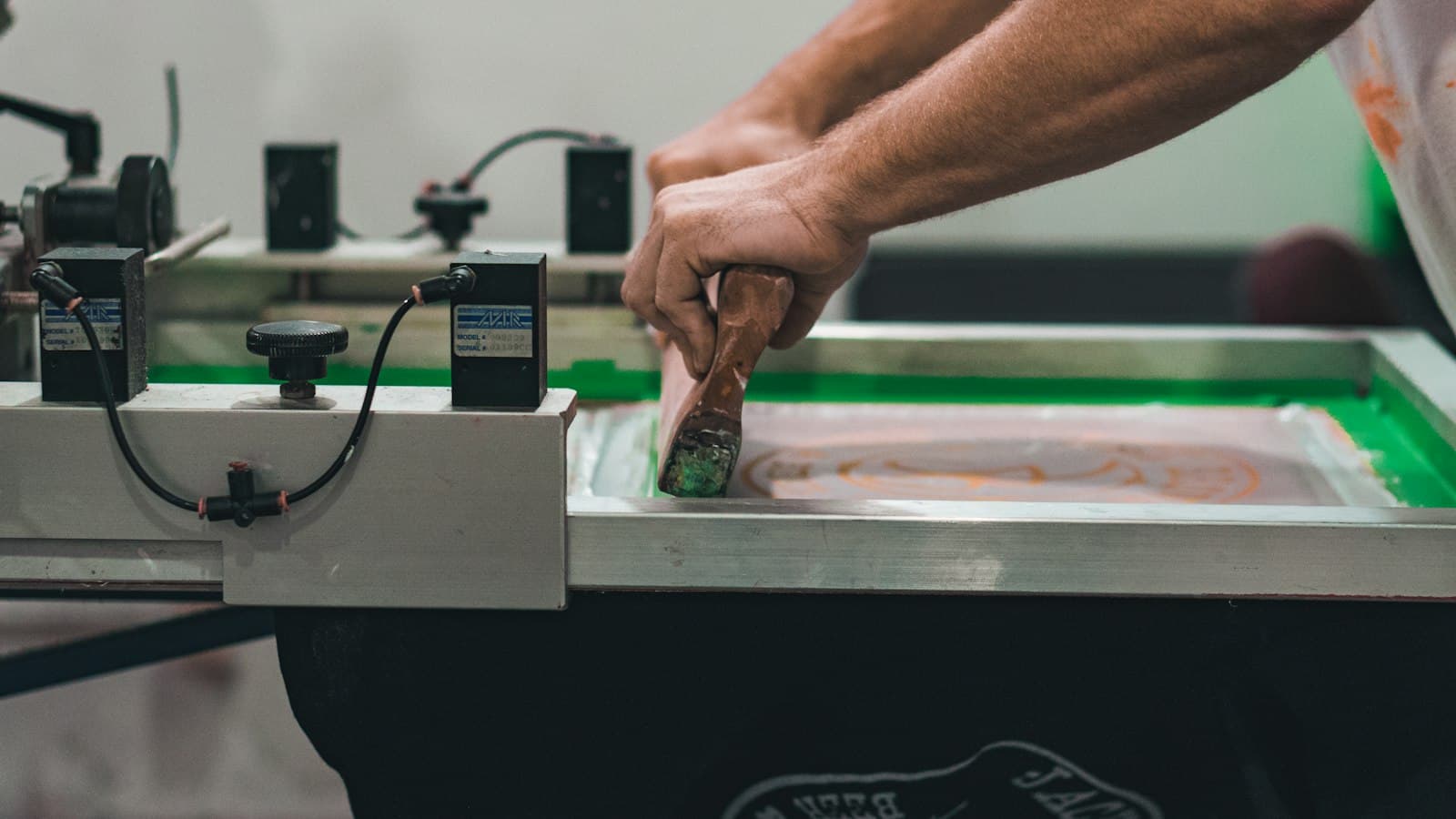
A screen has to be coated with emulsion, exposed, washed out, dried and taped before it reaches the press. Then the press itself has to be set up: screens loaded, registered against each other, ink mixed and matched, and test prints pulled until one is acceptable. Those are two different costs, which is why the shops that itemise tend to separate screen from press setup.
The important property is that none of it scales with quantity. Whether the run is 12 shirts or 1,200, the same three screens are burned and the same registration is done. That is why a single number expressed per screen behaves so differently depending on the order in front of you.
| Line | Typical 2026 range |
|---|---|
| Screen, per colour | $15 – $35 |
| Film, per colour | around $15 |
| Press setup, per location | around $25 |
| Each extra colour, running cost per shirt | $0.75 – $1.50 |
What does it do to a small order?
This is where the arithmetic stops being abstract. Take the same three-colour front print and change only the quantity. Using the middle of the published range — call it $25 a screen, so $75 of setup:
| Quantity | Setup per shirt | Share of a $10 price |
|---|---|---|
| 12 | $6.25 | 63% |
| 24 | $3.13 | 31% |
| 72 | $1.04 | 10% |
| 200 | $0.38 | 4% |
The trade figures agree with the shape of that: setup adds $3.75–$8.75 per shirt on a 12-piece run and under $0.53 per shirt at 200. At a dozen pieces, more than half of what the customer pays is the cost of getting ready to print. That is not a pricing failure — it is what the job is.
It does explain two things shops often treat as mysteries. Small orders feel busy and unprofitable because they are mostly setup. And a customer who has ordered 200 before will find your 12-piece price incomprehensible unless you show them this table. Most stop arguing once they can see it.
At twelve pieces you are not selling shirts. You are selling the setup, with shirts attached.
Why do "no setup fee" offers exist?
Because setup is unpopular and unit price is not. A shop advertising zero setup has usually done one of three things: raised the unit price to absorb it, set a minimum order high enough that setup disappears anyway, or limited the offer to designs of one or two colours where there is less to absorb.
None of that is dishonest, and for a customer ordering 200 pieces the bundled price may genuinely be lower. It becomes a problem only when it is compared against an itemised quote line by line. The right comparison is the total for the actual order, not the presence or absence of a setup line.
If you quote setup separately, say why in one sentence on the quote. Customers accept a charge they understand far more readily than one that simply appears, and it gives you an honest answer when they ask what changes if they drop a colour, and it is the foundation of a quantity break that holds up — which is a real saving, both in setup and in the per-shirt running cost.
How should you set your own number?
Time it rather than copy it, and hold the result where every quote draws on it — that is the quoting side of our back-office management. The published range is wide because shops genuinely differ — an automatic press with a trained crew and a screen already on file is not doing the same work as a manual press setting up a new four-colour job. Your number should come from your own stopwatch, then be sense-checked against the range rather than derived from it.
Three checks before you publish a setup fee
- Time a screen from coating to taped-and-ready, and a press setup from first screen to first good print
- Price them separately — a second location is press setup again, not screens again
- Set a minimum order from the arithmetic, not from habit; if setup is over half the price, the order needs a different process
That last point is worth acting on rather than absorbing. When the setup share climbs past about half, the job is telling you it does not belong on a screen press. A dozen pieces almost always costs less to produce digitally, where there is nothing to burn and nothing to register. Everything else in the pricing archive assumes you have found that crossover.
Do you charge setup again on a reorder?
Partly, and being clear about which part is where a lot of goodwill is won. The screens are gone — reclaimed and back in the rack — so those genuinely have to be made again. The artwork, the separations and the colour match are all on file, so that work does not repeat.
A reasonable structure is full screen cost, reduced press setup, on the grounds that registering a job you have run before with separations already correct is materially faster than doing it cold. Some shops go further and waive setup entirely on a reorder placed within a set window, which is a real incentive to reorder rather than shop around.
Whatever you choose, publish it. A customer who reorders and sees the same setup charge as the first time assumes nothing was kept, and concludes the charge is arbitrary. The same customer told "screens are $75 again, press setup is half because your artwork is on file" understands exactly what they are paying for and why ordering again was cheaper.